
Corporate Governance
Basic Approach to Corporate Governance
With our spirit of Monozukuri, or “making things,” as our starting point, represented by material, processing and surface treatment technologies that we have cultivated since the foundation in 1939, we, as the Company, are driving the business toward our corporate philosophy: “Realizing a clean environment and a sophisticated global society.” To this end, we are striving to enhance our corporate governance, believing that it is essential to achieve sustainable growth by offering unmatched technologies and products with superior value, as wells as by forging good relationships with shareholders, customers, and other stakeholders such as trading partners, local society, employees.
Basic Policy
Based on the basic policy below, we work to improve the effectiveness of Corporate Governance.
- We respect shareholders' rights and assure equality.
- We collaborate appropriately with everyone, including shareholders, employees, suppliers and regional societies.
- We make appropriate Company Information disclosures and assure transparency.
- Board Members and Auditors recognize their fiduciary responsibility and explanation responsibility, and appropriately fulfil their required role/responsibility.
- We work on constructive dialogue with shareholders.
Outline of Corporate Governance structure
We have adopted a company-with-auditors system as our institutional framework and are committed to building a corporate governance structure that ensures management transparency and soundness while achieving sustainable growth.
The Board Meeting has appointed several highly independent external directors and external auditors. In addition, we have established the Nomination and Remuneration Committee, whose majority of members are independent external directors, as an advisory body to the Board, in order to strengthen transparency and objectivity and enhance oversight from an external perspective. Furthermore, various committees, such as the Sustainability Promotion Committee, Compliance Committee, Risk Management Committee, and Safety & Hygiene Committee, have been established to further strengthen the soundness of management. The Auditors Meeting, as an independent body from the Board Meeting, audits the execution of duties by the directors, ensuring its appropriateness in close collaboration with the Internal Audit Department and the Internal Control Department.
Our company has also introduced an executive officer system in order to separate the management supervisory function from the execution of business operations to facilitate prompt decision-making and improve the efficiency of management execution.
Board Meeting
The Board Meeting consists of 10 directors, including 4 independent external directors with diverse backgrounds in the financial industry, manufacturing industry, legal profession, and foreign-affiliated companies, in order to enhance the corporate governance of our company. The Board Meeting is fully aware of its fiduciary duty and accountability to shareholders, and shall appropriately fulfill its roles and responsibilities to promote our company’s sustainable growth and medium- to long-term enhancement of corporate value, and to improve profitability, capital efficiency, etc.
Management Meeting
The Management Meeting is chaired by the Chairman and CEO and consists of the President and COO, Directors, and officers in charge of each division (overseas business, sales, production, administration, technology, etc.).
With the aim of increasing the efficiency and dynamism of Board deliberations, important matters are discussed by the Management Meeting, and, in principle, only matters agreed upon through such discussions are submitted to the Board Meeting.
Nomination and Remuneration Committee
The Committee consists of at least three members, with a majority being independent external directors. Accordingly, four of the five directors are external directors.
As an advisory body to the Board of Directors, the Committee reinforces transparency and objectivity in the nomination and remuneration of senior management.
The Committee also deliberates on matters related to the nomination and dismissal of directors and auditors, matters related to the composition of the Board of Directors and its policies on remuneration structure and other matters, and remuneration framework.
Auditors Meeting
The Auditors Meeting consists of a total of five auditors, three of whom are highly independent external auditors, to ensure a neutral and objective audit system. The members of the Auditors Meeting work closely with the Internal Audit Department and regularly exchange opinions with the accounting auditor to ensure appropriate and proper audits, thereby enhancing corporate governance. Our Auditors conduct audits in accordance with the audit policies and assignments determined by the Auditors Meeting.
Scroll sideways
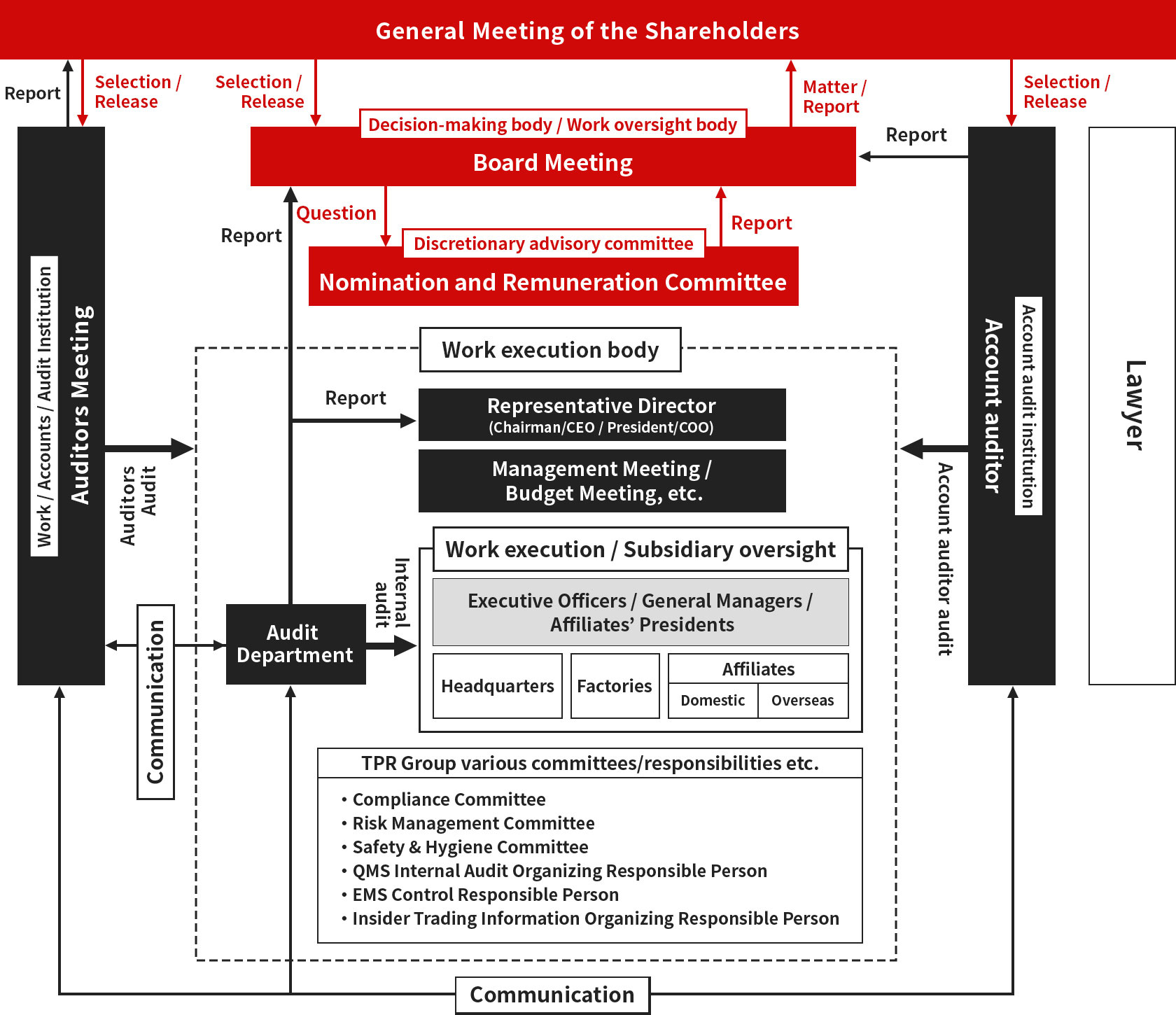
Outline of Corporate Governance structure
Scroll sideways
| Organization form | company with auditors |
|---|---|
| Board Members | 10 (of which, 4 are external Board Members) |
| Board Member term of office | 1 year |
| Number of Auditors | 5 (of which, 3 are external Auditors) |
| Number of Independent Officers | 4 external Board Members, 3 external Auditors |
| Number of Board Meetings held | 16 (FY2024) |
| Number of Auditor Meetings held | 14 (FY2024) |
| Number of Nomination and Remuneration Committee meetings held | 7 (FY2024) |
Board Member Remuneration, etc.
Basic Policy
The Company’s basic policy is to ensure that the Director remuneration is linked to the Company’s business performance and medium- to long-term corporate value so that it can fully function as an incentive for the sustainable enhancement of corporate value, and to determine the remuneration of individual Directors at an appropriate level based on their respective responsibilities and achievements. More specifically, the remuneration of executive Directors shall consist of ordinary remuneration, variable remuneration and share-based remuneration for officers granted by Board Benefit Trust as an incentive to raise awareness about enhancing corporate value. In contrast, non-executive Directors receive ordinary remuneration and share-based remuneration while Audit & Supervisory Board Members only ordinary remuneration.
Board Members' Remuneration
(1) Management remuneration (monetary remuneration)
Ordinary remuneration is a fixed monthly salary, determined by considering the position, the level of compensation at other organizations for said duties, performance of the Company and the level of employee salaries from a broad perspective.
(2) Variable remuneration (monetary remuneration)
Variable remuneration aims to increase a Director’s incentive to enhance business performance each year. The amount is calculated based on the business environment, the corporate performance in the previous fiscal year and the contributions to the performance by each executive Director, divided by 12, and then paid together with the ordinary remuneration. Based on the business environment, the Company has established the targets for business performance such as the consolidated ordinary income laid out in the Mid-term Management Plan or proper indicators according to the duties of each executive Director at the time when preparing plans. Such targets or indicators are appropriately revised depending on changing business environment, reflecting the opinion from the Nominating and Remuneration Committee with a majority of independent Outside Directors.
Non-executive Directors and Audit & Supervisory Board Members don’t receive variable remuneration.
(3) Share-based remuneration (non-monetary remuneration
Non-monetary remuneration is share-based remuneration through the Board Benefit Trust and is paid in accordance with the “Officer Stock Benefit Rules” in order to ensure that the remuneration system is linked to medium- to long-term corporate value enhancement. More specifically, non-monetary remuneration shall be a point system based on position wherein points are assigned according to a table at a certain time each year. In addition, the non-monetary remuneration shall be paid at the end of the Director’s term of office, mainly by converting point granted to a Director during the tenure to one share, which shall be paid at the time of retirement. In the event that shares are paid out during the term of office of a Director, the transfer or other disposition of such shares shall be restricted until the retirement of said Director by entering into a restricted transfer agreement. Directors who engage in certain illegal or inappropriate acts shall lose their rights to receive the provision of the Company share, etc.
(4) Policy for determining the ratio of remuneration by type
The Nominating and Remuneration Committee considers the ratio of each type of Director remuneration based on a standard level of remuneration in reference to corporate groups with approximately the same size or in the relevant industry, so that Directors with higher position receive higher proportion of the remuneration which links with Company business performance and corporate value. The Board of Directors shall determine the ratio of each type of remuneration based on the opinion from the Nominating and Remuneration Committee.
(5) Matters regarding determination of remunerations for each Director
The specific details about the amount of remuneration for each Director shall be delegated to the Representative Director, Chairman & CEO by resolution of the Board of Directors, and his authority shall be to decide the amount of ordinary remuneration and the amount of variable remuneration based on the evaluation of the business performance of each Director. The Board of Directors shall consult with the Nominating and Remuneration Committee on the original proposals prepared by the Representative Director, Chairman & CEO to ensure the Representative Director, Chairman & CEO is appropriately exercising this authority, and the Representative Director, Chairman & CEO shall make a decision in accordance with content of that report.
Internal Control
In addition to formulating the “Basic Policies for Establishment of Internal Control Systems” based on the TPR’s corporate philosophy, the Company has ensured the appropriateness of operations, promoted the construction of a more effective internal control system and strived to achieve continual improvements.
With regard to the internal control reporting system related to financial reporting required by the Financial Instruments and Exchange Act (so-called J-SOX), the Company is actively implementing initiatives and taking suitable and appropriate measures while receiving expert advice.